Welcome!
I am a sixth-year Ph.D. candidate in Economics at Bocconi University in Milan, where my advisors are Basile Grassi, Thomas Le Barbanchon and Jérôme Adda.
I will be on the 2026/2027 academic job market.
My research focuses on how workers sort across jobs and the consequences for human capital and wages. I am particularly interested in how uncertainty shapes the behaviour of firms and workers and how those responses affect the aggregate economy.
Research interests: Macroeconomics, Labor Economics, and Structural Econometrics.
In Spring 2026, I visited the Stanford Economics Department as a Visiting Student Researcher, hosted by Luigi Bocola. During Spring 2025, I was a Visiting Student Research Collaborator at Princeton University, hosted by Gianluca Violante.
Research
Job Market Paper
Presented at the NBER Summer Institute – The Micro and Macro Perspectives of the Aggregate Labor Market
Work in Progress
“The Experimentation Value of Occupations” (Draft available soon)
“Promoting Inequality: Internal Job Ladders and Wage Dynamics”
Teaching
Bocconi University, Milan (Italy)
- Monetary Theory and Policy (30159, Bachelor) — Fall 2022 – Present
- Economia – Modulo 2 (Macroeconomia) (30066, Bachelor) — Fall 2022 – Present
- Financial Macroeconomics (30172, Bachelor) — Fall 2022 – Fall 2024
- Econometrics (30462, Bachelor) — Fall 2022 – Fall 2024
Resources
Computational Economics (Link to GitHub Repository)
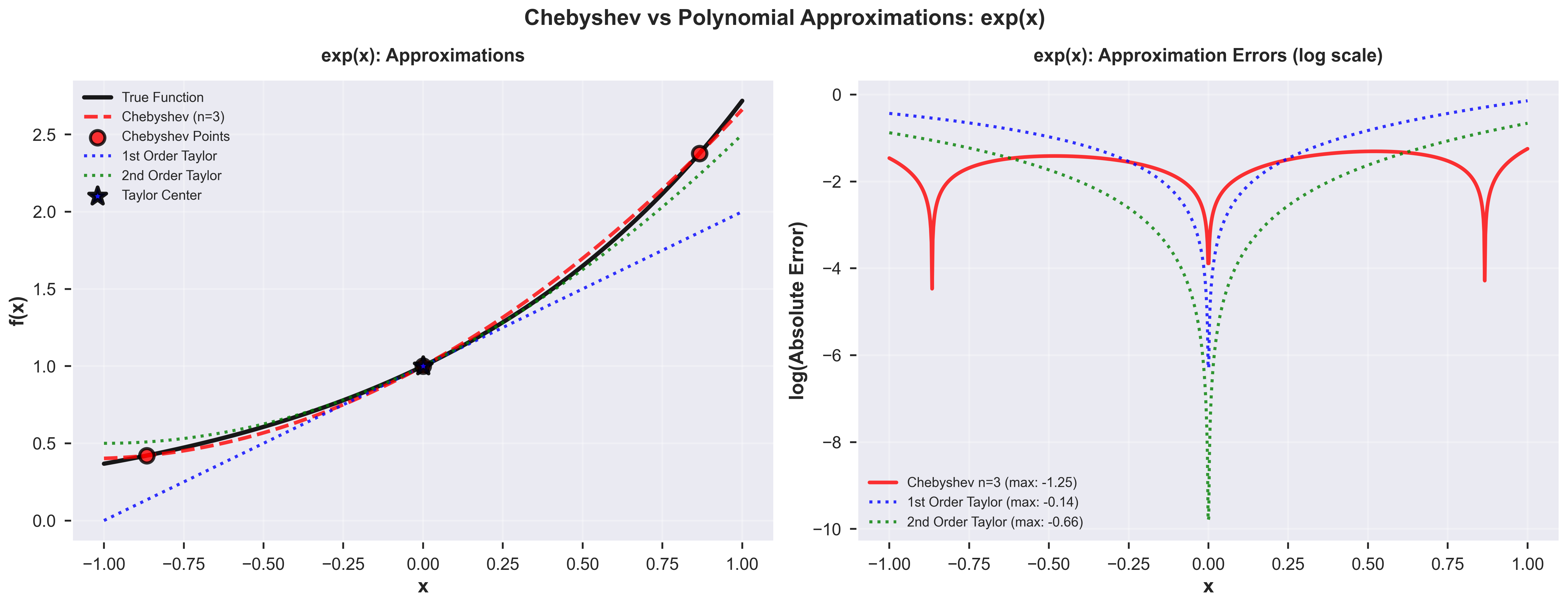
Python implementations of projection methods (Chebyshev polynomials) for solving dynamic models, applied to the Neoclassical Growth Model — first the approximation machinery itself, then a global solution of the stochastic NGM with endogenous labor supply.
Why Chebyshev polynomials
Chebyshev nodes deliver near-uniform accuracy on smooth functions, where a Taylor expansion is only accurate near the point it expands around.
Stochastic NGM with endogenous labor
Policy functions for consumption and labor, $c(k,z)$ and $l(k,z)$, solved globally. Euler residuals vanish as the polynomial degree rises, confirming high global accuracy.
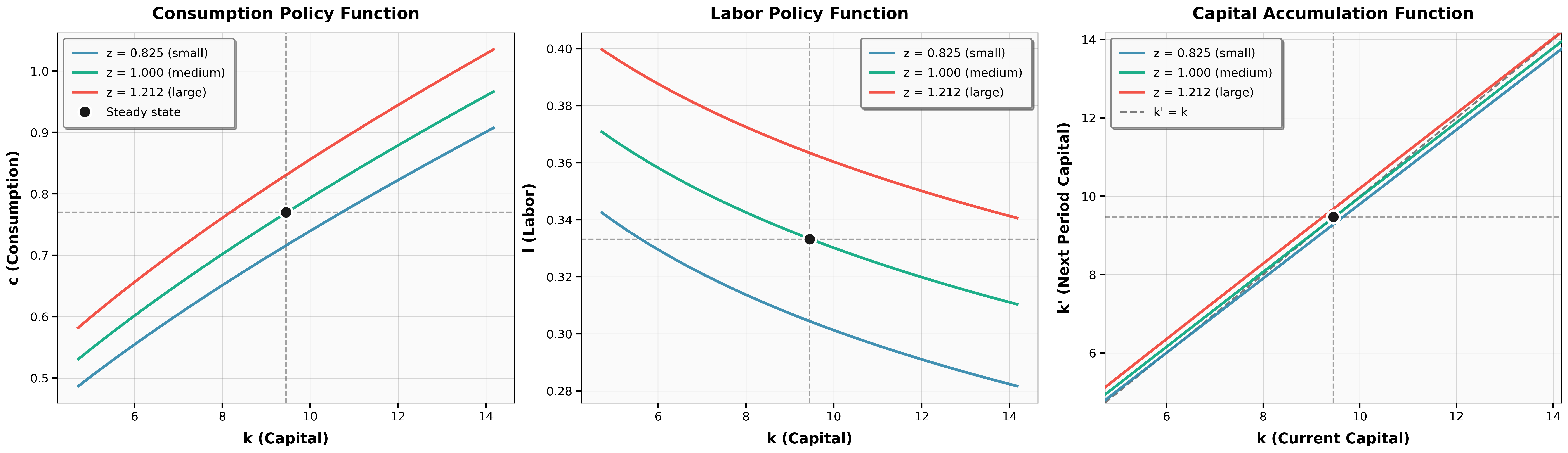
Calibrated to standard quarterly values ($\beta = 0.99$, $\alpha = 0.33$, $\delta = 0.025$, $\rho = 0.95$). Full derivations, the remaining figures, the Euler-error diagnostics and the code are in the repository.